Tax Season Meets Ganeshotsav: 7 Deadlines and GST Traps Every Mandal, Donor and Sponsor Risks Overlooking
Decoration bills, sponsorship GST, donation deduction rules and a critical tax audit cutoff—what Ganeshotsav organisers and businesses must clear by September 30th
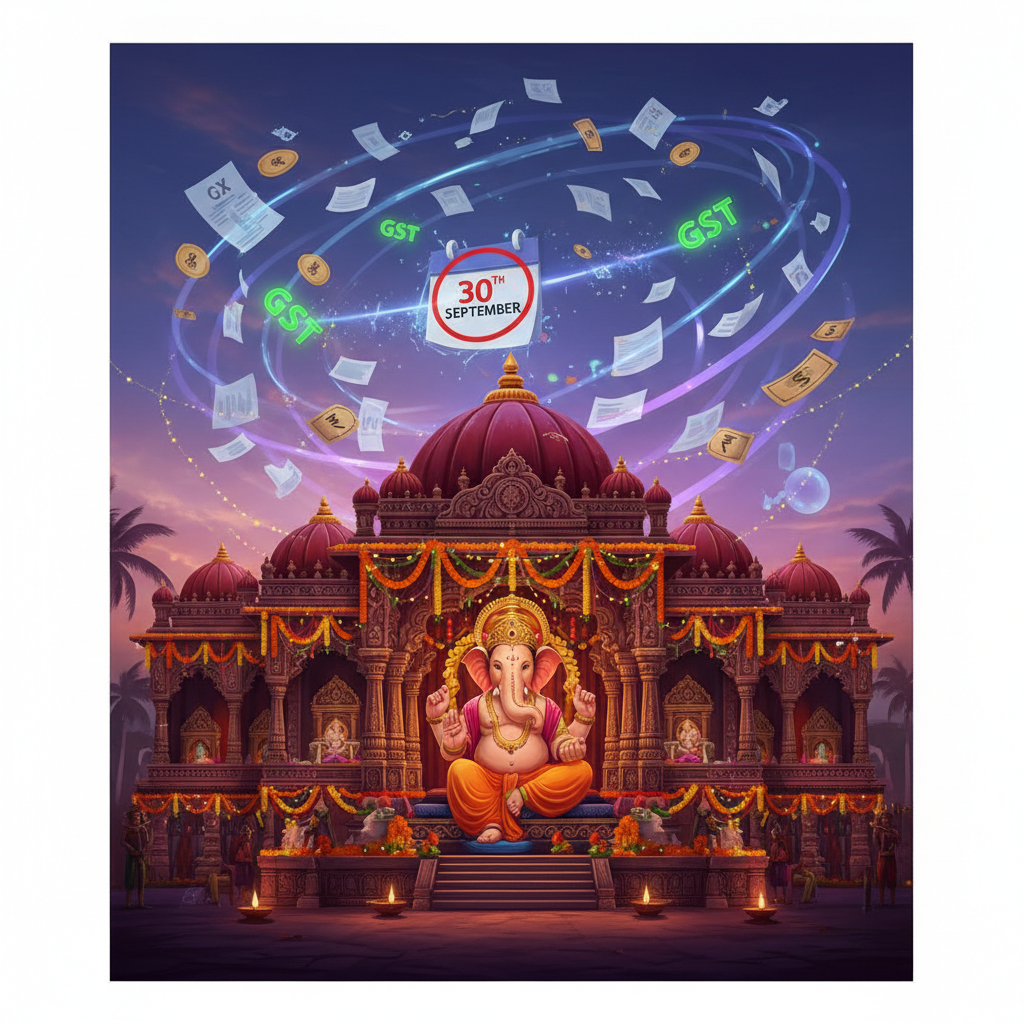
Why Ganeshotsav Season Is Crunch Time for Tax Compliance
As Ganesh Chaturthi celebrations fill the streets, the September 30th tax filing and audit deadline looms. For businesses, Ganesh Mandals, sponsors, and donors, this festive month isn’t just about decorations—essential GST, donation deductibility, and audit rules apply. Missing even one can mean steep penalties or the loss of valuable tax benefits.
GST on Decoration & Related Services: When Mandaps Bring Tax Liability
Many Ganesh Mandals and corporates hire mandap-keepers, decorators, and light-sound service providers. Under GST:
- GST at 18% applies to such services once the provider crosses the GST registration threshold (Rs. 20 lakh for most states, Rs. 10 lakh in special category states).
- Mandap-keeper, tent house, florists, and light-and-sound rental bills above this threshold must carry GST, and ITC (Input Tax Credit) can be claimed if you’re GST-registered.
- Businesses and organizers should insist on proper GST invoices to ensure compliance and claim ITC.
Common Pitfall: Small, unregistered vendors may not charge GST—there’s no tax liability unless they cross the registration threshold. Large providers must charge GST, and not collecting/remitting this is an avoidable risk.
GST on Sponsorships: The Reverse Charge Mechanism Trap
Companies often sponsor Ganesh Mandals, with branding or banners in return. This isn’t just a donation—it’s a taxable sponsorship service.
- GST on sponsorship (at 18%) is required
- Under RCM, the sponsoring company, not the Mandal, must pay GST directly if the Mandal is unregistered or a registered trust.
- Failure to pay GST under RCM can mean interest and penalty.
Advice: Sponsors must check the Mandal’s GST status before finalising, and must remit GST under RCM within due dates.
Donation Deductions: The Section 80G and 12A Maze
Donating to Ganesh Mandals can bring the warmth of giving—and the disappointment of disallowed deductions if paperwork is ignored.
- Section 80G deduction is allowed only if the Mandal/trust is registered under Section 12A and has valid 80G approval.
- Most Ganesh Mandals don’t have these registrations.
- Only 50% of your donation (within the eligible limit) is deductible.
- Cash donations above Rs. 2,000 are not deductible under Section 80G.
- If you opt for the new tax regime (Section 115BAC), no 80G deduction is available.
Practical tip: Always get a proper 80G receipt and check registration certificates before donating if you want a tax break.
CSR on Ganeshotsav: What Corporate Donors Get Wrong
For companies, spending on Ganeshotsav as part of CSR? The law is very clear:
- CSR activities are strictly disallowed as a business expense for tax purposes if spent on religious (Ganeshotsav) events (Explanation 2 to Section 37(1), Income Tax Act).
- In rare cases, a separate Section 80G deduction may be possible if the donation meets all strict approval and compliance conditions—but this is uncommon.
30th September: The Not-to-Miss Tax Audit Deadline
For businesses and mandals/trusts whose books must be tax-audited, September 30th is the last date to file the audit report.
- Miss the deadline? The penalty is 0.5% of turnover/gross receipts (up to Rs. 1.5 lakh) under Section 271B.
- Further, late filing of subsequent ITRs can attract interest and additional penalties.
Quick-Reference Table: Ganeshotsav Tax Figurations
| Issue | Who’s Affected | Key Rule or Pitfall |
|---|---|---|
| Decoration, Mandap, Light | Businesses, Mandals | 18% GST if provider is registered |
| Sponsorship (branding, ads) | Companies, Mandals | RCM GST (18%) by sponsor |
| Donations | Individual/corporate donors | Sec 80G only if Mandal is 12A+80G |
| Cash donations | All donors | Not deductible >Rs 2,000 |
| CSR expenditure | Corporate donors | Not allowed as business expense |
| Tax audit filings | Businesses, Mandals, trusts | Due by 30th September |
Take Action: Compliance Checklist for Ganpati Season
- Check vendor GST registration for all event service providers above threshold.
- Confirm & pay RCM GST on sponsorship payments.
- Insist on valid 80G receipts for any donation seeking tax benefit.
- Avoid cash donations above Rs 2,000 for deduction.
- Do not treat Ganeshotsav CSR as business expense in tax computation.
- File tax audit reports by September 30th to dodge penalty.
FAQs
Frequently asked questions
Is GST always applicable on Ganeshotsav decoration expenses?
GST at 18% is applicable only if the decorator or mandap service provider crosses the GST registration turnover threshold and is registered; otherwise, no GST is charged.
Who is responsible for paying GST on sponsorship during Ganeshotsav?
The sponsoring company must pay GST at 18% under Reverse Charge Mechanism (RCM) if the Mandal is unregistered or registered as a trust and provides advertising services.
Can I claim tax deduction for donations to all Ganesh Mandals?
No, deductions under Section 80G are only allowed if the Mandal or trust is registered under Section 12A and 80G with valid approval; otherwise, no benefit is available.
Is a cash donation to a Mandal eligible for Section 80G deduction?
No, cash donations above Rs. 2,000 to any trust or organization, including Mandals, are not eligible for Section 80G deductions.
What is the penalty for late filing of tax audit reports related to Ganeshotsav expenses?
If the tax audit report is filed after 30th September, the penalty is 0.5% of turnover/gross receipts, up to a maximum of Rs. 1,50,000 under Section 271B.
Is CSR spend on Ganeshotsav tax deductible as business expense?
No, CSR expenditure on religious events like Ganeshotsav is expressly disallowed as a business expense under Explanation 2 to Section 37(1).