Will GST Make Your UPI Payments Costlier? What Merchants Need to Know About MDR, GST and Input Credit
The new 0.4% MDR and 18% GST on select UPI merchant payments: costs, exemptions and clarity for business owners
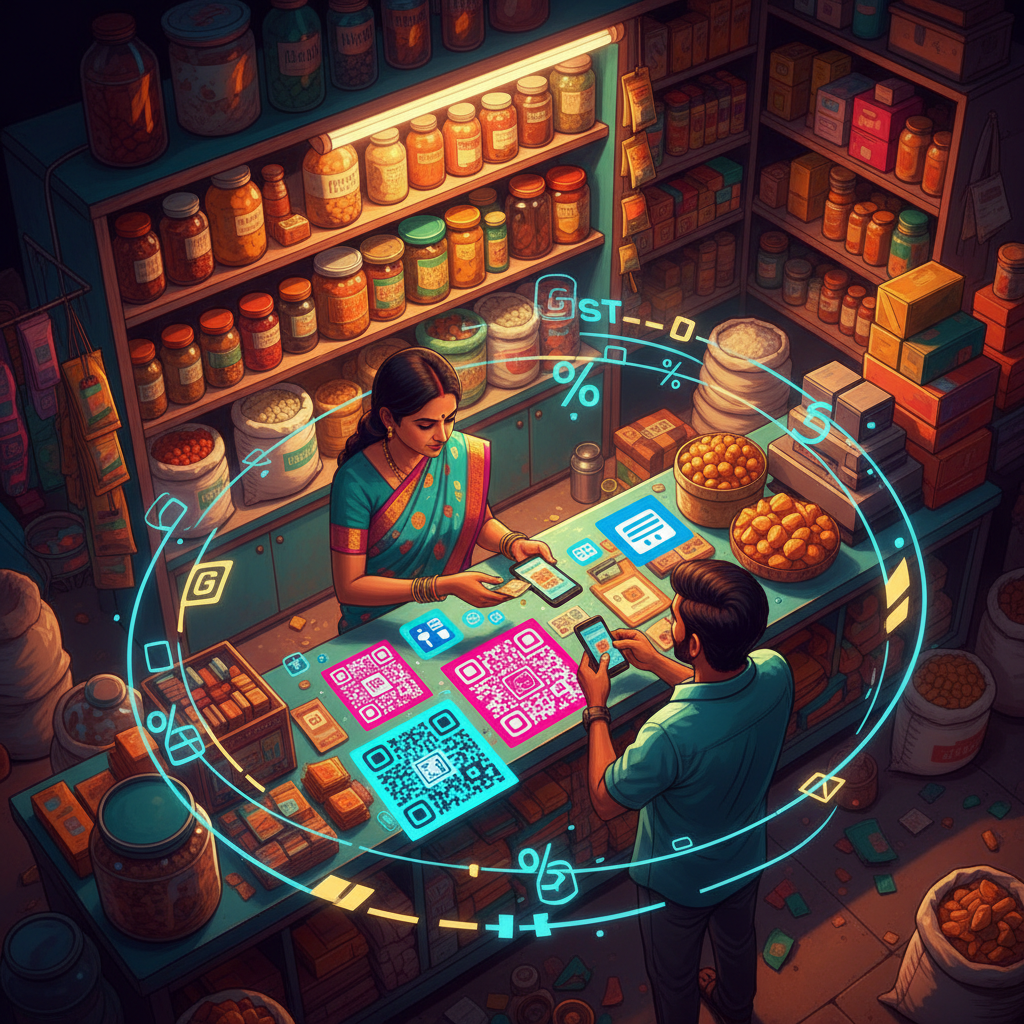
Why UPI Payments Are Changing for Merchants—But Customers Stay Unaffected
Starting 15 October 2026, India's enormously popular UPI payment system will see a new round of compliance rules for merchants: on select transactions above ₹2,000, a 0.4% Merchant Discount Rate (MDR) will apply—as will an 18% GST, but crucially only on the MDR. This move ends the "zero-MDR" regime put in place in 2020 for most person-to-merchant (P2M) digital payments. Fears have swirled online about GST charges being added to customer bills for UPI payments—these are unfounded, but the changes matter greatly to merchants and business owners accepting UPI.
What Is MDR, and When Does It Apply?
- MDR is a payment processing fee: Banks and UPI app providers levy MDR to cover their costs and infrastructure. It applies to digital acceptance: when a customer pays a merchant by UPI.
- From 15 October 2026, MDR of 0.4% (capped at ₹300 per transaction) applies to person-to-merchant UPI payments above ₹2,000. Select sectors (fuel, railways, mobile recharge, insurance) will see a ₹5 flat MDR per transaction.
- No MDR for UPI person-to-person transfers (e.g., sending money to a friend or family member) or merchant payments up to ₹2,000—these remain free.
Where Does GST Come In?
- GST at 18% only applies to MDR, not the value of the sale. For example, on a ₹10,000 UPI transaction, the MDR is ₹40; GST is 18% of ₹40 = ₹7.20. The total deduction from the merchant's account is ₹40 + ₹7.20 = ₹47.20.
- There is NO GST on the item price or for customers—customers pay the invoice/purchase price only. GST on MDR is a business expense for the merchant, not the consumer.
Who Pays MDR and GST on UPI?
- Merchants always bear the MDR and its GST, never the customer for eligible UPI transactions. RBI, NPCI (the UPI operator), and government have clarified merchants cannot add MDR or GST as a surcharge on the invoice or receipt.
- GST-registered merchants: can claim the GST paid on MDR as Input Tax Credit (ITC), reducing their effective GST burden.
- Merchants under GST composition scheme or unregistered: cannot claim ITC. For them, both MDR and its GST are a final cost.
Table: How the Rule Applies
| Scenario | UPI Amount | MDR Applied | GST on MDR | ITC Available? | Cost to Merchant | Cost to Customer |
|---|---|---|---|---|---|---|
| Grocery store (GST registered) | ₹3,000 | 0.4% = ₹12 | ₹2.16 | Yes | ₹12 (MDR), but GST offset by ITC | ₹3,000 |
| Stationery shop (Composition scheme) | ₹2,100 | 0.4% = ₹8.4 | ₹1.51 | No | ₹9.91 | ₹2,100 |
| Restaurant (transaction ₹1,700) | ₹1,700 | Nil | Nil | N/A | Nil | ₹1,700 |
| Person-to-person transfer | ₹10,000 | Nil | Nil | N/A | Nil | ₹10,000 |
Special Sectors
Some sectors (fuel, railways, mobile recharges, insurance) will have a flat ₹5 MDR per eligible transaction instead of the 0.4% formula. Detailed sectoral notification is awaited, but the general GST-on-MDR treatment will apply.
What Merchants Must Track
- GST Registration Status: Only regular (not composition) GST-registered merchants can claim ITC for GST on MDR, which reduces their tax outflow.
- Transaction Value: MDR and GST apply only to UPI sales above ₹2,000. Smaller transactions remain unaffected.
- Invoice Disclosure: There is no requirement or right to add an MDR or its GST as a separate charge to the customer's bill.
- Documentation: GST ITC can only be claimed if proper documentation from your bank/payment provider is received and matches your GSTR-2B.
Customer Perspective: No Change and No Hidden Fees
For consumers, UPI payments up to and beyond ₹2,000 remain simple: the full invoice amount is paid, and no processing or GST charge is added. Merchants must not add a surcharge on UPI payments.
Why This Matters for Small Businesses and Startups
For GST-registered businesses, the real cost increase from this change is minimal, since the GST on MDR can be fully offset. But composition scheme users and unregistered businesses—often the smallest—cannot claim ITC, and so for them, MDR + GST becomes a real additional cost that chips away at margins. This continues the trend of digital payments increasingly favouring larger, more formalised businesses in cost terms.
Points Pending Final Clarification
- The GST Council and relevant ministries have yet to issue detailed clarifications for some sector-specific rules and operational fine print (such as process details for ITC on MDR, and enforcement against merchant surcharging).
- The list of sectors eligible for special MDR remains to be finalised.
- Further documentation requirements for GST ITC claims may issue closer to the framework's effective date.
Key Takeaways for Merchants and Taxpayers
- UPI payments remain cost-free to customers; MDR and GST on MDR are merchant-side charges only.
- GST on MDR is reclaimable as ITC for regular GST-registered merchants, but not for composition/unregistered merchants.
- MDR of 0.4% (capped at ₹300) applies only for P2M UPI transactions above ₹2,000—smaller sales and all P2P transfers remain charge-free.
- Sector-specific MDR caps apply to select industries; further details awaited.
- Guardianship against merchant surcharges on UPI is in force: passing costs to customers is prohibited.
FAQs
Q1: Will I pay extra GST or MDR if I pay by UPI at a store?
No. As a customer, you pay only your invoice amount. MDR and GST on MDR are settled between the merchant and payment providers; they cannot be added to your bill.
Q2: If I'm a small GST-registered shop, can I recover GST on MDR?
Yes, if you are a regular (not composition) GST registrant, you can claim Input Tax Credit on GST paid on MDR, provided you have the proper documentation and the tax appears in your GSTR-2B.
Q3: What if I'm under the GST composition scheme or unregistered?
You cannot claim ITC for GST paid on MDR. Both MDR and GST become final costs to your business when accepting eligible UPI payments.
Q4: Does MDR or GST apply on UPI person-to-person transfers?
No. There is no MDR or GST on any person-to-person UPI payments, regardless of amount.
Q5: Can a merchant add a surcharge or separate line for MDR or GST on customer bills?
No. Regulations prohibit merchants from passing MDR or GST as a surcharge to customers. The full invoice price should match what the customer pays via UPI.
Q6: What documentation is required to claim ITC on GST paid on MDR?
Merchants must obtain valid GST invoices from their bank or payment provider reflecting the GST on MDR, and the credit must appear in their GSTR-2B to be eligible for ITC.
Frequently asked questions
Will I pay extra GST or MDR if I pay by UPI at a store?
No, customers pay only the invoice amount. MDR and GST on MDR are charges between merchants and payment providers, not passed to customers.
If I'm a small GST-registered shop, can I recover GST on MDR?
Yes, regular GST-registered merchants can claim Input Tax Credit on GST paid on MDR, with proper documentation and subject to GSTR-2B reflection.
What if I'm under the GST composition scheme or unregistered?
Merchants under the composition scheme or unregistered cannot claim ITC and bear both MDR and GST on MDR as a final business cost.
Does MDR or GST apply on UPI person-to-person transfers?
No, MDR and GST do not apply to UPI person-to-person (P2P) transfers, irrespective of the transaction amount.
Can a merchant add a surcharge or separate line for MDR or GST on customer bills?
No, regulations prohibit merchants from passing MDR or GST on MDR as a surcharge to customers. The customer pays only the billed amount.
What documentation is required to claim ITC on GST paid on MDR?
Merchants must obtain a GST invoice from their payment provider, and the credit must appear in their GSTR-2B to claim Input Tax Credit.