SCSS vs Post Office MIS vs Bank FD: Best Monthly Income for a ₹30 Lakh Investment
Comparing income, eligibility, tax impact and practical limits for senior citizens and regular investors
Regular Income Options for ₹30 Lakh: The Core Question
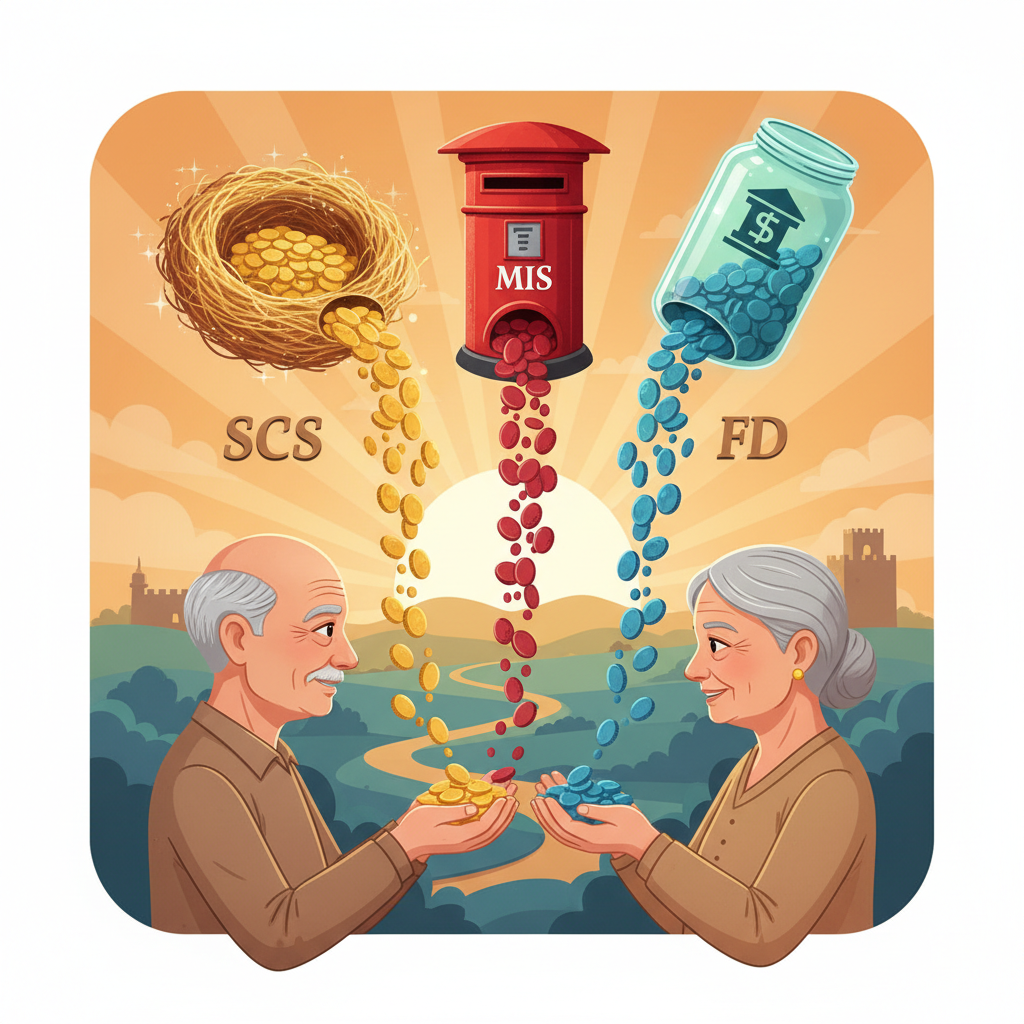
For Indian investors—especially retirees and those seeking steady monthly payouts—deciding where to invest a large sum for regular income is crucial. The three major fixed-income options are:
- Senior Citizen Savings Scheme (SCSS): A government-backed scheme for senior citizens, offering high, assured returns but with deposit and eligibility restrictions.
- Post Office Monthly Income Scheme (MIS): A post office product providing monthly guaranteed payouts, but with strict deposit ceilings.
- Bank Fixed Deposits (FDs): Ubiquitous, flexible, and accessible to most investors, but with widely varying interest rates and terms.
This article unpacks which of these three gives the highest monthly income on a ₹30 lakh investment, and what practical, legal and tax aspects must be understood before committing funds.
---
How Each Scheme Works—and Who Can Invest
| Product | Eligibility | Interest Rate (p.a.) | Maximum Deposit | Payout Frequency |
|---|---|---|---|---|
| SCSS | 60+ years old (or 55+ with special conditions) | 8.2% (April–Sept 2026) | ₹30 lakh (from FY 2023-24) | Quarterly (but can be calculated monthly) |
| PO MIS | Any Indian resident; any age | 7.4% (April–Sept 2026) | ₹15 lakh per individual or joint account | Monthly |
| Bank FD | Any individual (higher rates for seniors in some banks) | 6.5%–8.5% (varies by bank & category) | No fixed ceiling (subject to bank rules) | Usually flexible: monthly/quarterly/annual |
Key Points on Limits
- SCSS: Only senior citizens or certain retirees may invest, up to ₹30 lakh per person.
- PO MIS: Per account, max ₹15 lakh. Two joint accounts (e.g., husband & wife) can double the total.
- Bank FDs: No legal ceiling, but deposit insurance only covers up to ₹5 lakh per depositor per bank.
---
What Monthly Income Does Each Option Offer on ₹30 Lakh?
Let’s break down the numbers:
Senior Citizen Savings Scheme (SCSS)
- Interest Rate: 8.2% p.a., paid quarterly
- Annual Interest: ₹30,00,000 × 8.2% = ₹2,46,000
- Monthly Equivalent: ₹2,46,000 ÷ 12 ≈ ₹20,500
- Actual payout: Quarterly (every three months), so actual cash flow arrives in larger chunks.
Post Office Monthly Income Scheme (MIS)
- Interest Rate: 7.4% p.a., paid monthly
- Max Per Account: ₹15 lakh; two joint accounts = ₹30 lakh
- Monthly Income per Account: ₹15,00,000 × 7.4% ÷ 12 ≈ ₹9,250
- Total for Two Accounts: ₹18,500/month (split across two accounts, e.g., spouses)
Bank Fixed Deposits (FDs)
- Interest Rate: 6.5%–8.5% (varies widely)
- Monthly Income:
- At 6.5%: ₹30,00,000 × 6.5% ÷ 12 ≈ ₹16,250
- At 8.5% (most likely for senior citizens or special tenures): ₹30,00,000 × 8.5% ÷ 12 ≈ ₹21,250
- Payout frequency may be monthly, quarterly, or as chosen, depending on the bank.
Important Practical Differences
Deposit Ceilings
- SCSS allows up to ₹30 lakh per eligible senior. Younger investors are not eligible.
- MIS is limited per account; splitting money between family members (within rules) is needed to reach ₹30 lakh.
- FDs have no deposit ceiling, but only ₹5 lakh per depositor per bank is covered by deposit insurance.
Lock-in and Liquidity
- SCSS: 5-year tenure (extendable by 3 years); premature withdrawal possible with penalty.
- MIS: 5-year lock-in (premature closure allowed after 1 year with penalty).
- FD: Flexible tenures (7 days to 10 years); largely liquid, but premature withdrawal often carries reduced interest or fees.
Taxation
- Income from all three options is fully taxable at your slab rate.
- TDS applies to FD interest above ₹40,000/year (₹50,000 for seniors), and SCSS. No TDS on post office MIS, but income is still taxable.
- No investment here offers Section 80C deduction, except SCSS (up to ₹1.5 lakh per financial year, as per current rules).
Which Option Provides the Highest Income—and for Whom?
- For Senior Citizens:
- SCSS offers the highest assured monthly-equivalent income (₹20,500).
- Quarterly payout, but net annual interest is highest for eligible investors.
- For Non-Seniors:
- MIS is the next best assured option if you can split the deposit across family member accounts (max ₹15 lakh per account).
- For Flexible Depositors:
- Some banks may offer senior citizen FDs above the SCSS rate, especially in special limited-time offers—but this is rare and may change.
Quick Worked Example
For a retiree and spouse, both over 60, possible structures:
| Investment | Option | Income per Month | Payout Mode |
|---|---|---|---|
| ₹30 lakh | SCSS (self) | ₹20,500 eqv. | Quarterly |
| ₹30 lakh | MIS (split two) | ₹18,500 | Monthly |
| ₹30 lakh | FD @ 8.5% | ₹21,250 | Flexible |
---
Caveats and Recommendations
- Interest rates change periodically, so check latest government/bank notifications before committing funds.
- Consider maturity, tax, and liquidity before investing: higher returns may mean less flexibility, stricter rules, or limited eligibility.
- Consult a qualified advisor for large investments, especially for tax and estate planning.
---
Key Takeaways
- SCSS is the best regular income option for most senior citizens with ₹30 lakh.
- Post Office MIS is suitable for those seeking monthly payouts but can't use SCSS or want diversification.
- FDs are most flexible and can sometimes match or beat SCSS/MIS, but only for select seniors and for as long as high rates last.
Frequently asked questions
Who can invest in the Senior Citizen Savings Scheme (SCSS)?
Only individuals aged 60 or above, or certain retirees aged 55 and above (as per scheme rules), can invest in SCSS.
What is the maximum deposit allowed in Post Office MIS?
The maximum deposit per individual or joint MIS account is ₹15 lakh; two joint accounts can reach a combined total of ₹30 lakh.
Is the interest from SCSS, MIS, and FDs tax-free?
No, interest from all three is fully taxable at the investor's applicable slab rate. TDS applies to SCSS and FDs above the relevant thresholds.
Can bank FDs offer better returns than SCSS or MIS?
Some banks may offer senior citizen FDs up to 8.5%, which can give slightly higher monthly income than SCSS, but these rates and tenures vary and are often temporary.
How often are payouts made in SCSS, MIS, and FDs?
SCSS pays interest quarterly, MIS pays monthly, and FDs can offer monthly, quarterly, or annual interest payouts depending on the chosen option.