Education Loan in Your Name or Your Child’s? The Repayment and Tax Nuances Families Often Miss
Why choosing who is the primary borrower on an education loan could make a long-term tax and financial difference — and how government schemes may affect your decision.
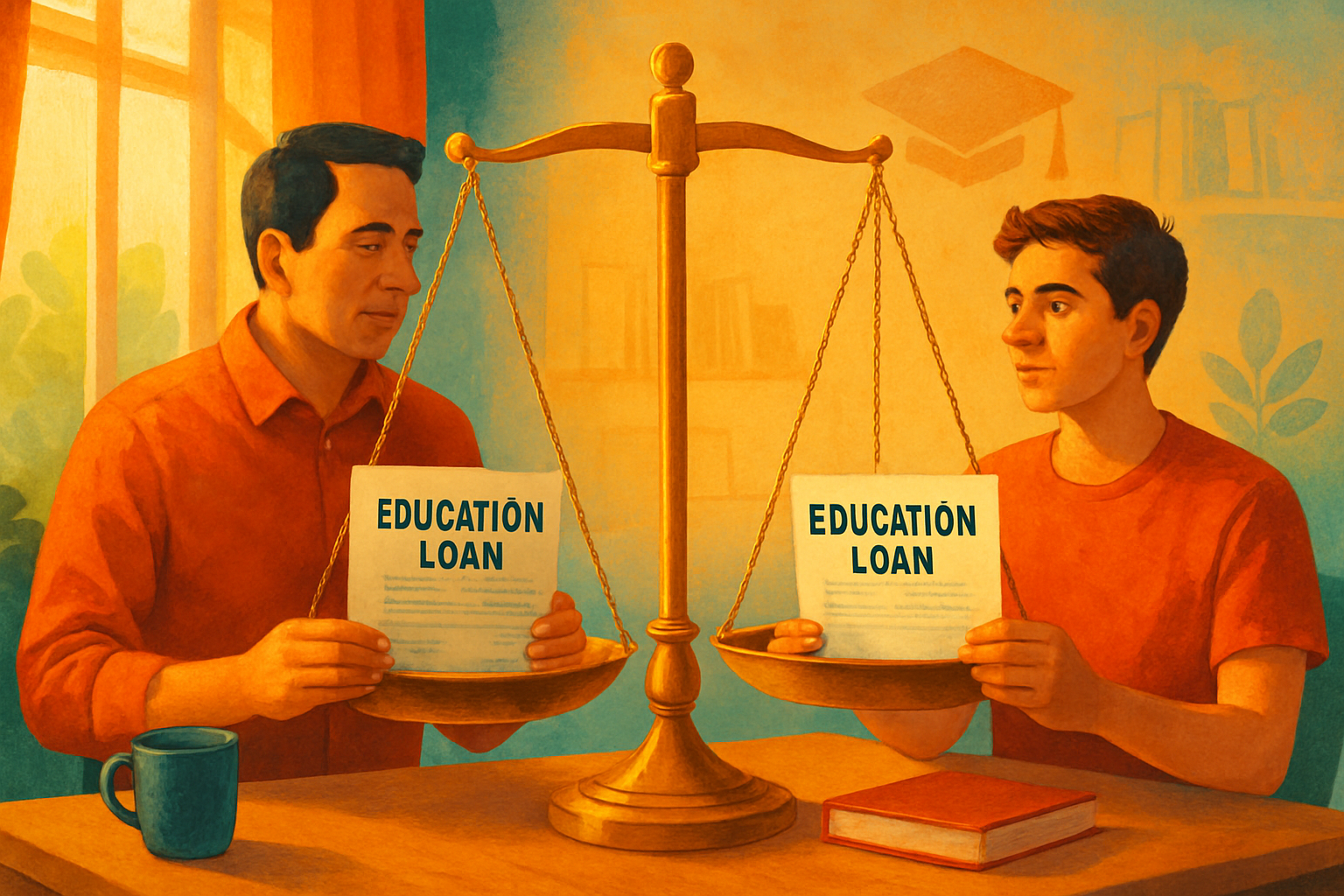
Who Can Be the Primary Borrower — and Why It Matters
When funding higher education through a loan, banks generally require the student to be the primary borrower, with a parent or guardian as co-borrower or guarantor. This arrangement is not just procedural — it shapes your loan terms, repayment responsibilities, tax advantages, credit history, and even eligibility for government interest relief schemes.
Loan Approval and Repayment: Key Differences
Lenders assess the student’s future earning potential (course type, likely income, placement record) to approve the loan, since they will ultimately repay it post-graduation. However, the parent’s financial profile is also key, especially if the loan is large or if the student has no current income.
If the parent is the primary borrower, repayment must come from their income. If the student is primary, the obligation and related credit history start in their name — useful for building a financial track record, but also risking early default if job prospects falter.
Who Repays? Practical Scenarios
- If the student lands a good job promptly, having the loan in their name keeps parental finances and credit unaffected — useful if parents are nearing retirement.
- If the student delays employment or earnings are less than expected, the burden may shift to parents anyway, regardless of the loan’s name.
Tax Deduction under Section 80E: Parent or Student?
Section 80E of the Income-tax Act allows a deduction on interest paid for education loans, with these key features:
- Available only under the old tax regime.
- No upper cap on deduction claimed — only the interest paid matters (principal does not qualify).
- Applicable for eight consecutive assessment years starting from the year repayment begins, or until full interest is paid (whichever is earlier).
Only the person who actually pays the interest can claim the deduction, and only if the loan was taken for self, spouse, or children.
Implication: If the parent pays from their income, the parent can claim the Section 80E deduction (potentially more valuable if in a higher tax bracket). If the student pays, and has sufficient taxable income, the student may claim the deduction — but many fresh graduates won't have enough taxable income in initial years.
Government Scheme: PM-Vidyalaxmi Interest Relief
Government-supported loans (like those linked to the PM-Vidyalaxmi portal) provide additional interest relief for families meeting certain conditions:
| Income Level | Interest Benefit During Study/Moratorium |
|---|---|
| Up to ₹4.5 lakh | 100% interest waiver |
| ₹4.5 lakh–₹8 lakh | 3% subvention on interest |
- The scheme is for select Indian institutions/courses only, not overseas study.
- Income tests (parental/family income) determine eligibility, not just borrower’s name.
- Changing who is listed as primary borrower does not affect income-based benefits.
- Required family income proof will be checked by the lender under the scheme.
Weighing the Practical Trade-offs
Before deciding who should be the primary borrower:
- Assess the student’s likely employment prospects, time to secure a job, and starting salary.
- Consider the parent’s age, retirement plans, credit exposure, and cash-flow obligations.
- Review which person would benefit more from the Section 80E tax deduction (old regime), given their respective tax brackets and income projections during the deduction period.
- Check eligibility and ongoing requirements for government interest subvention or waiver schemes.
- Factor in any impact on the parent’s ability to obtain other loans in the future.
- Carefully read and compare the loan sanction letter, interest calculation (especially for moratorium period), and penalty clauses if initial repayments are missed.
Example: Claiming Section 80E on Loan Interest
Suppose a parent whose taxable income is ₹12 lakh pays ₹1.2 lakh as loan interest in a financial year. Under old regime:
- Entire ₹1.2 lakh is available as Section 80E deduction, reducing taxable income (and tax outgo) substantially.
If the student (newly employed, taxable income ₹4 lakh) claims it, up to ₹1.2 lakh can be deducted, but actual tax saving would be less, as their tax liability is already low and may be within the basic exemption/87A rebate limit.
What Documentation Is Needed?
- Loan sanction letter specifying borrower and co-borrower
- Admission offer from eligible institution
- Proof of family income for government schemes
- Documentation of interest paid to claim Section 80E
Quick Takeaways
- Section 80E deduction is valuable but only for those with adequate taxable income under old regime
- Schemes like PM-Vidyalaxmi are driven by family income, not just the loan applicant’s profile
- Early career students may not maximize tax savings, but building their credit history could help future borrowing
- Parents must consider the loan’s effect on their retirement, other liabilities, and financial goals before assuming repayment responsibilities
- The loan must be for higher education (India or abroad) for Section 80E, but PM-Vidyalaxmi covers only study in India
Frequently asked questions
Who can claim the Section 80E deduction on education loan interest?
Only the individual who actually pays the loan interest can claim the deduction, and only under the old income tax regime. If the parent pays, the parent claims; if the student pays, the student claims.
Does it matter for PM-Vidyalaxmi benefits whether the student or parent is the primary borrower?
No, the interest subvention/waiver under PM-Vidyalaxmi is based on the family’s income, not on whether the student or parent is the primary borrower.
Can education loan interest deduction be claimed under the new income tax regime?
No, Section 80E deduction is not available under the new tax regime. Taxpayers must opt for the old regime to claim this benefit.
What happens if the student is unable to repay after graduation?
The responsibility will ultimately fall on the co-borrower or guarantor (usually the parent), who will be liable for repayment and may see an impact on their credit history.
Does PM-Vidyalaxmi scheme cover education loans for overseas study?
No, PM-Vidyalaxmi only supports loans for study in approved institutions in India; overseas courses are not eligible.